

Structural Issues of Barium Screening
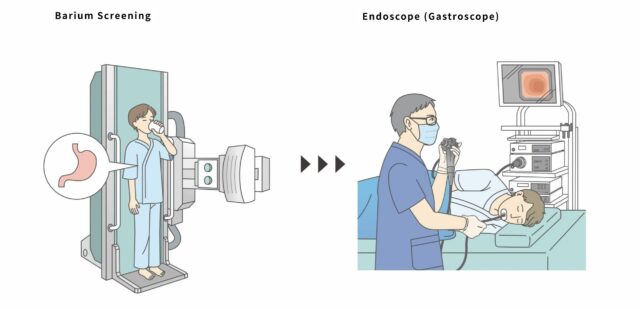
Gastric cancer screening in Japan has relied primarily on barium-based X-ray examinations for over 50 years since the 1970s. Even today, approximately 90% of screening participants undergo barium tests, with more than 20 million people relying on this method annually.
However, despite significant advances in medical technology, various limitations of this system have become increasingly apparent.
Limited Detection Accuracy
Barium screening visualizes the shape of the stomach as a shadow using X-rays. Due to this fundamental limitation, it is difficult to detect small or flat lesions. Since many early-stage cancers present as flat lesions, there is always a risk of missed detection. This poses a critical challenge in achieving the primary goal of cancer screening: early detection and early treatment.
Radiation Exposure
Barium screening requires continuous X-ray exposure to observe gastric movement, resulting in a non-negligible radiation dose. A particular concern is the cumulative effect of annual screening. This creates a paradox in which a procedure intended to protect health may potentially increase cancer risk.
Physical and Psychological Burden on Patients
Barium sulfate, a heavy metal compound, must be fully excreted after the examination. If not, it can lead to serious complications such as bowel obstruction or, in severe cases, intestinal perforation. In addition, the examination process—which requires patients to rotate their bodies on a tilting table—can be particularly burdensome for elderly individuals and those with limited mobility.
Limitations of Conventional Endoscopy in Screening
While there is growing demand to shift from barium screening to endoscopic screening, current endoscopic systems are not suited for large-scale screening.
Over-Specification
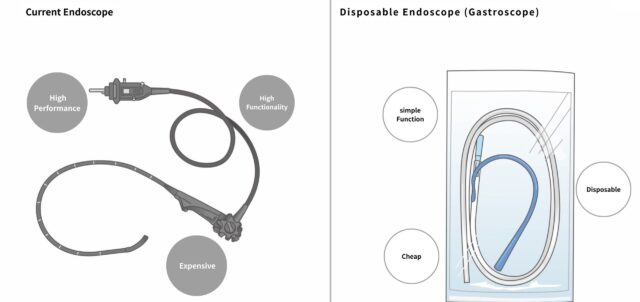
Modern endoscopes have evolved into highly advanced tools for diagnosis and treatment—so sophisticated they could be described as “over-engineered” for screening purposes. Equipped with ultra-high resolution, image-enhanced modalities, and magnification functions, these devices can cost several million yen per unit. However, screening primarily requires the identification of suspicious lesions, making many of these advanced features unnecessary.
Throughput Bottlenecks
Another major limitation is the time required for cleaning, disinfection, and drying after each use. Each endoscope requires significant downtime before it can be reused, limiting the number of examinations that can be performed per day and making large-scale screening impractical.
Infection Risk from Reusable Devices
Current endoscopes are reusable devices that require thorough reprocessing after each use. However, even with strict protocols, the risk of infection can never be completely eliminated.
There have been reported cases of infection-related deaths due to inadequate disinfection. The occurrence of such incidents in cancer screening—intended to safeguard health—is unacceptable.
Economic Barriers
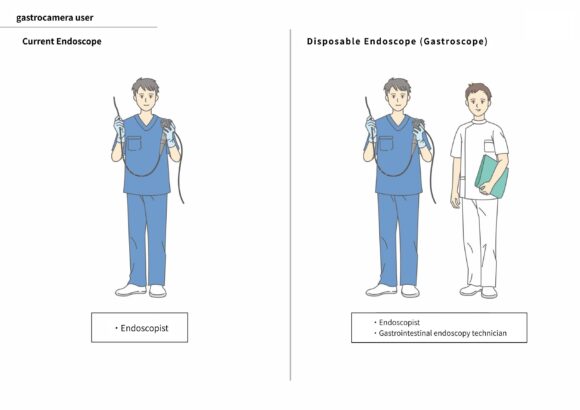
Introducing an endoscopic system requires substantial upfront investment—not only for the endoscope itself but also for washers, disinfection equipment, and dedicated examination rooms. In addition, operation requires highly trained endoscopists, making training both time-consuming and costly. As a result, only a limited number of healthcare institutions can offer endoscopic screening.
Our
A Screening-Specific Endoscopic System
We propose a fundamentally different approach. Rather than simplifying existing diagnostic endoscopes, we adopt a “zero-based development” approach—building from the ground up only the functions required for screening.
Our screening-specific disposable endoscope (gastroscope) is the first of its kind in the world. With the world’s thinnest diameter, it minimizes patient discomfort. Its fully single-use design eliminates the need for cleaning, disinfection, and drying, allowing the next examination to begin immediately with zero downtime.
Each device is individually packaged and sterilized, ensuring safe use without infection risk.
Accessible Pricing and Reduced Infrastructure Requirements
Our system is designed to be affordable within the typical out-of-pocket cost of current gastroscopy screening, ensuring no additional financial burden for patients.
Healthcare providers can adopt the system without large capital investment. By utilizing a tablet-based system, expensive endoscopy towers are no longer required. This enables even small and mid-sized clinics to offer endoscopic screening, significantly expanding access.
Improved Accuracy and Efficiency with AI
Our AI-powered diagnostic support system, optimized for screening, helps reduce missed lesions.
In addition, each disposable endoscope is assigned a unique ID at the time of manufacturing, enabling a one-to-one linkage between each device and each patient’s examination data. This ensures precise data management and allows for full automation of reporting processes, including submissions to municipalities.
As a result, physician workload is reduced while the quality of screening is significantly improved.
Toward a New Era of Screening
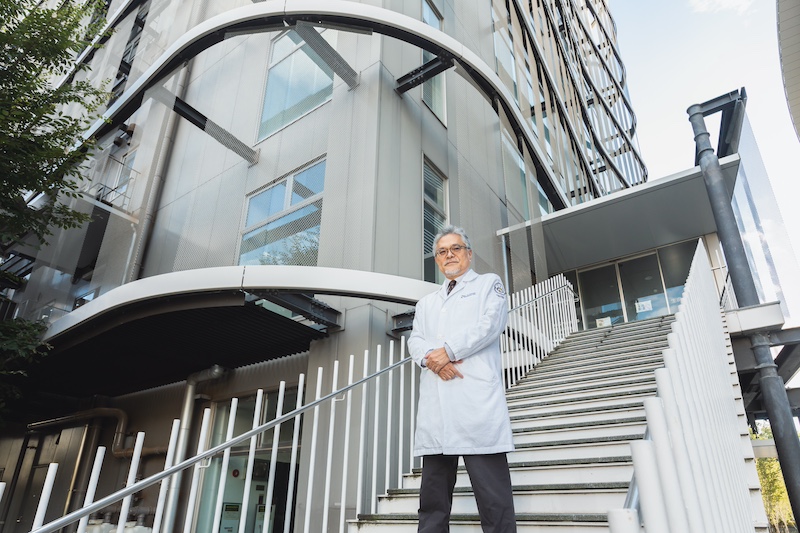
While various discussions are ongoing regarding the limitations of barium screening, what truly matters is establishing a practical and scalable alternative.
We respect the historical role that barium screening has played in early detection of gastric cancer in Japan. However, the time has come to build a new screening system aligned with advances in medical technology.
Endoluminal Solutions Inc. provides a concrete and practical solution. We aim to transform gastric cancer screening—used by tens of millions of people—into a safer, more accurate, and more accessible system.
This transformation is not merely about changing a diagnostic method. It represents the evolution of Japan’s screening system into one suited for the 21st century—contributing to longer, healthier lives.
Furthermore, we aim to expand this model globally and contribute to the advancement of healthcare worldwide, supporting the realization of Universal Health Coverage.