

Disposable endoscope (gastroscope) specialized for medical examination
The world's first endoscopy system developed exclusively for medical examinations
For over 50 years since the 1970s, barium tests have been the mainstream method of stomach cancer screening in Japan. However, there has now been a gradual shift to endoscopic screening. However, existing endoscopes have become more sophisticated for precision examinations, and their cost of several million yen per endoscope and complex operation make them difficult to adapt for large-scale screening.
As an expert in medical device development, our founder and representative director, Seiichi Nakajima, had long been aware of this structural problem. The functions required for detailed examinations and medical checkups are fundamentally different. Medical checkups are generally aimed at healthy people, and screening for suspicious lesions is sufficient. Therefore, we embarked on the development of the world's first disposable endoscope (gastroscope) specialized for medical checkups, using "zero-based development" to build from scratch only the functions necessary for medical checkups.
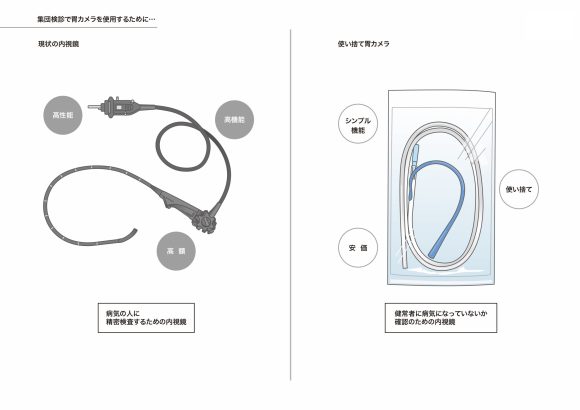
A new screening system made possible by four innovations
The world's thinnest diameter and minimal pain
The world's thinnest diameter is optimized for nasal insertion. The design allows for easy insertion through the nose, significantly reducing the gag reflex that occurs when using an endoscope inserted through the mouth. The simple design allows for easy up and down operation, enabling efficient observations required for medical examinations.
Completely disposable and zero downtime
The biggest innovation is the completely disposable system. It can be introduced without increasing the financial burden on patients, as it is priced within the current personal costs of gastroscopy screening. The previously required cleaning, disinfection, and drying processes are no longer necessary, making it possible to test any number of people consecutively. This dramatically improves the processing capacity of screening centers while simultaneously achieving significant cost reductions.
Furthermore, instead of using a large endoscope tower, the system connects to a tablet device, and by placing an LED light source at the tip, optical fiber and expensive light sources are no longer necessary, resulting in a significant reduction in capital investment.
Sterilized and individually packaged
The endoscopes are "sterilized" with a higher level of quality than the "disinfection" required for current endoscopes, and are individually packaged, virtually eliminating the risk of infection.
Current endoscopes are cleaned, disinfected, dried, and reused after use. Because they undergo this process, the risk of infection depends on the accuracy and operation of the process. Disposable endoscopes (gastroscopes) are sterilized during the manufacturing process and are provided individually packaged. This guarantees sterility, and they are disposed of immediately after use. Using a new endoscope for each patient reduces the risk of infection to as close to zero as possible.
AI diagnostic support: Achieving both accuracy and efficiency
In contrast to the simplified hardware, the software is equipped with cutting-edge technology. An AI diagnostic system specialized for screening automatically detects suspicious lesions and creates reports automatically. This demonstrates that the accuracy required for screening can be ensured even without the high resolution of current endoscopes.
Taking advantage of the device's completely disposable characteristics, each endoscope is assigned an individual ID during the manufacturing process. By dedicating one endoscope to one patient, test data and patient information are perfectly matched one-to-one. This significantly improves the accuracy of test history management, and automates reporting to patients, secondary facilities, and local governments. It is also expected to contribute to epidemiological research using big data in the future.
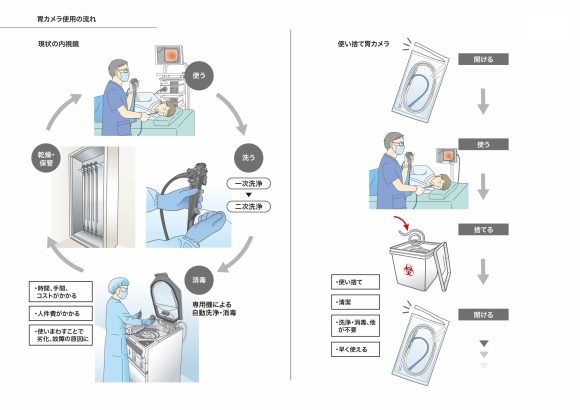
Transforming stomach cancer screening in Japan
For medical institutions
Endoscopic screening can now be introduced without a large initial investment. Small and medium-sized clinics can now participate, greatly expanding the range of facilities offering screening. Because there is no downtime, the number of people who can be examined per day increases dramatically. The effort and cost of cleaning and disinfection can also be reduced.
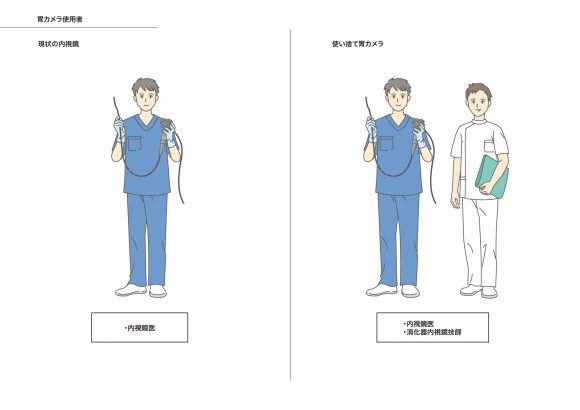
For patients
The world's thinnest and least painful design significantly reduces the psychological hurdles for patients regarding screening. Out-of-pocket expenses are also kept below those of conventional screenings, and it is expected that safer screenings with no radiation exposure or risk of infection will become more widespread.
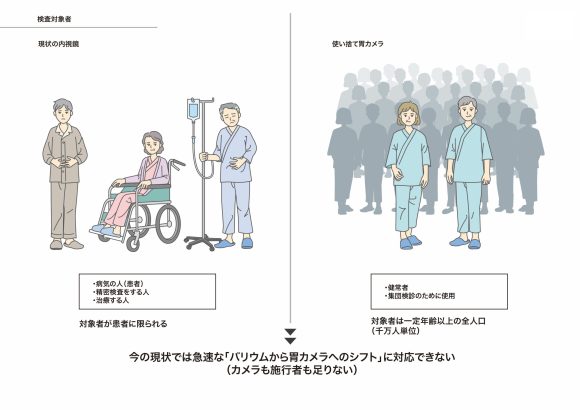
As society as a whole
Our endoscope will increase the cancer screening rate (currently around 40%), creating a huge market of tens of millions of people. This will enable more early detection and treatment, leading to reduced medical costs.
The path to global expansion
After the trial in Japan, we plan to expand into Asian markets such as South Korea, Singapore, Thailand, and China. In emerging countries where endoscopy is not yet widespread, it has the potential to become a popular first endoscopy. Because it is fully sterilized, it is expected to have a variety of applications, such as use during surgery in medical settings.
The first prototype is currently being manufactured by a partner manufacturer. After further refinements, we aim to bring it to market between 2029 and early 2030. Preparations are also underway for approval under the Pharmaceuticals and Medical Devices Act.
Through this product, we will realize the philosophy of our company name: "Creating solutions from the inside of organs (endoluminal)." We will revolutionize stomach cancer screening in Japan and share this successful model with the world. This is the challenge that Endoluminal Solutions Inc. is taking on.