


The limits of a screening system that has remained unchanged for 50 years
Why is a revolution in gastric cancer screening necessary now?
Structural problems with barium tests
For over 50 years since the 1970s, stomach cancer screening in Japan has mainly relied on barium tests. Even today, approximately 90% of people undergoing screening undergo barium tests, and more than 20 million people rely on this testing method annually. However, with today's dramatic advances in medical technology, various issues with this system have become apparent.
Limits of detection accuracy
Barium tests use X-rays to project the shape of the stomach like a shadow puppet. This fundamental limitation makes it difficult to detect small or flat lesions. Many early-stage cancers are flat, and there is always a risk of overlooking them. In order to achieve the ultimate goal of cancer screening, "early detection and early treatment," this issue of detection accuracy is an important area for improvement.
radiation exposure
Barium tests involve continuous X-ray irradiation to observe stomach movement. The amount of radiation exposure is not small. Particularly problematic is the cumulative effect of undergoing annual screening. This creates a contradiction: screenings that are meant to protect health may in fact increase the risk of cancer.
Psychological and physical burden on patients
Barium sulfate, a heavy metal compound, can cause serious problems such as intestinal blockages or, in the worst case, intestinal rupture if it is not properly excreted from the body after the examination. Additionally, the examination method, which requires patients to rotate on the examination table, places a great burden on elderly and physically disabled people.
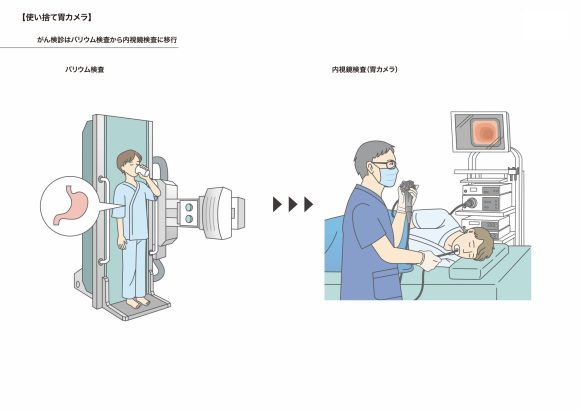
Issues with current endoscopy in screening
There is certainly a growing demand for endoscopy instead of barium, but current endoscopy systems are not suitable for large-scale screening.
The negative effects of excessive functionality
Today's endoscopes have evolved into tools for precision examinations, and can be called "monster endoscopes." They cost several million yen each and are equipped with a variety of features, including ultra-high resolution, special light observation capabilities, and magnification observation capabilities. However, what is needed for medical examinations is screening for suspicious lesions, and these advanced features are not necessary.
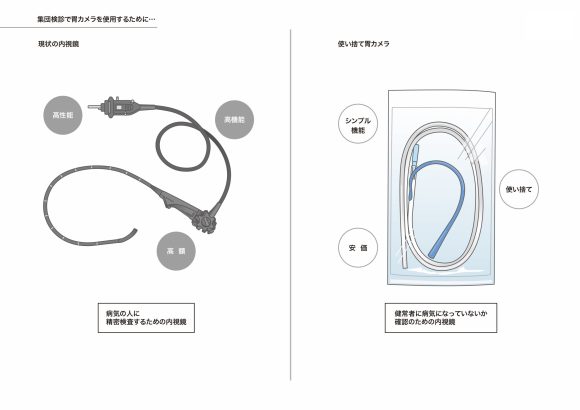
Processing capacity bottleneck
Another issue is the time required to clean, disinfect, and dry endoscopes. After using one endoscope, there is a downtime of several tens of minutes or more before it can be used on the next patient. This limits the number of people who can be examined per day, making it impossible to handle large-scale screening.
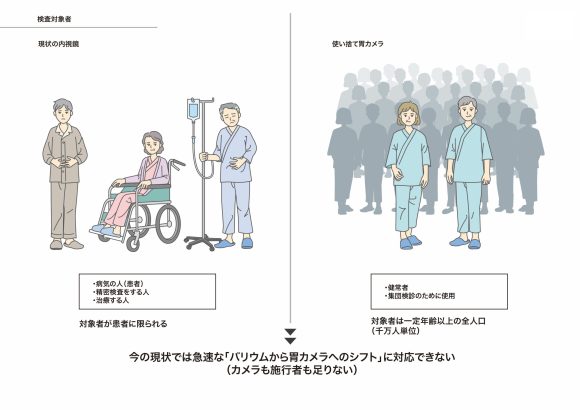
Infection risk from reusable endoscopes
Current endoscopes are reusable and require cleaning, disinfection, and drying after each use. However, no matter how carefully these processes are carried out, the risk of infection cannot be completely eliminated.
In the past, there have been cases of death due to infection caused by insufficient disinfection of endoscopes. We believe that it is unacceptable for an infection accident to occur during a cancer screening test.
Economic hurdles
Introducing an endoscopic system requires a large initial investment, not only for the device itself, but also for washing machines, disinfection equipment, and a dedicated examination room. Furthermore, the complex operations require skilled endoscopists, and training these personnel takes time and money. Due to these factors, the number of medical institutions that can perform endoscopic examinations is currently limited.
Endoluminal Solutions
Proposed Solution
We propose a fundamentally different approach to these problems.
A new endoscopy system specialized for medical examinations
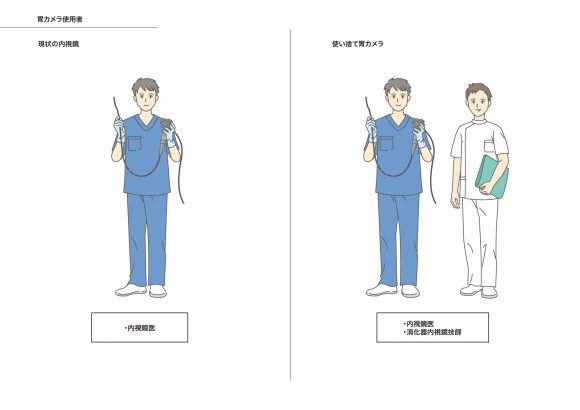
Rather than downgrading endoscopes for precision examinations, we have developed the world's first disposable endoscope (gastroscope) specifically for screening, using "zero-based development" to build from scratch only the functions necessary for screening. The world's thinnest diameter minimizes discomfort, and the fully disposable system eliminates the need for post-use cleaning, disinfection, and drying processes, allowing users to begin the next examination immediately after opening a new endoscope, eliminating waiting times. The endoscopes are individually packaged and sterilized, ensuring safe use without the risk of infection.
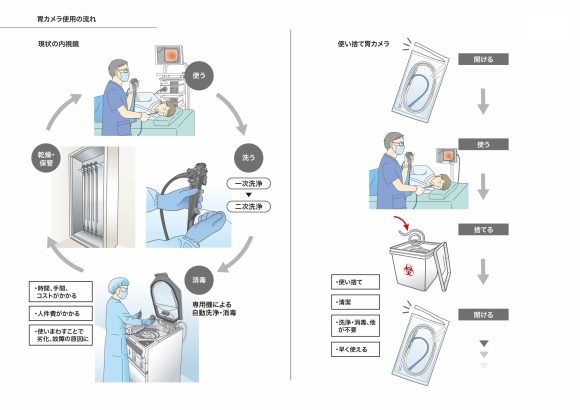
Affordable price and reduced capital investment
Pricing will be within the current personal costs of gastroscopy screening, so medical institutions can introduce the system without a large initial investment, without increasing the financial burden on patients. The use of a tablet-connected system also eliminates the need for expensive endoscopy towers. This will enable even small and medium-sized clinics to enter the endoscopic screening market, significantly expanding the range of facilities offering screening.
AI improves accuracy and efficiency
This AI diagnostic support system, specialized for screening, prevents suspicious lesions from being overlooked. Furthermore, by taking full advantage of the characteristics of disposable endoscopes, the system uses individual IDs assigned at the time of manufacture to ensure a one-to-one correspondence between each endoscope and each patient's examination data. This reliable link dramatically improves the accuracy of examination history management, and fully automates reporting to and creating reports for local governments. This makes it possible to improve the quality of screening while reducing the burden on doctors.
Towards a new era of screening systems
There is currently much discussion about the issues surrounding barium tests, but the important thing is to establish a viable alternative. While we respect the historical role that barium tests have played in the early detection of stomach cancer in Japan, we believe that the time has come to build a new screening system that takes advantage of advances in medical technology.
Endoluminal Solutions Inc. provides concrete, practical solutions. Our mission is to make stomach cancer screening, which is performed by tens of millions of people in Japan, safer, more accurate, and more accessible.
This transformation will not simply involve changing testing methods. It will evolve Japan's gastric cancer screening system itself into a form appropriate for the 21st century, contributing to extending the healthy lifespan of the nation's citizens. Furthermore, this successful model will be expanded globally, contributing to the improvement of global medical care (Universal Health Coverage).